The Tibetan National Flag
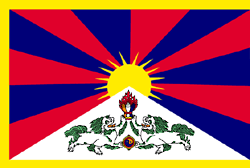
(click here for a larger version)
HISTORICAL BACKGROUND
During the reign of the seventh-century king, Songtsen Gampo, Tibet was one of the mightiest empires in Central Asia. Tibet, then, had an army of 2,860,000 men. Each regiment of the army had its own banner. The banner of Ya-ru To regiment
had a pair of snow lions facing each other, that of Ya-ru Ma a snow lion standing upright, springing upwards towards the sky, and that of U-ru To a white flame against a red background.
This tradition continued until the Thirteenth Dalai Lama designed a new banner and issued a proclamation for its
adoption by all the military establishments. This banner became the present Tibetan national flag.
Explanation of the Symbolism of the Tibetan National Flag
- In the centre stands a magnificient snow-clad mountain, which represents the great nation of Tibet, widely known as
the Land Surrounded by Snow Mountains.
- The Six red bands spread across the dark blue sky represent the original ancestors of the Tibetan people: the six
tribes called Se, Mu, Dong, Tong, Dru, and Ra which in turn gave rise to the (twelve) descendants. The combination of
six red bands (for the tribes) and six dark blue bands (for the sky) represents the unceasing enactment of the virtuous
deeds of protection of the spiritual teachings and secular life by the black and red guardian protector deities with
which Tibet has been connected since times immemorial.
- At the top of the snowy mountain, the sun with its rays shinning brilliantly in all directions represents the equal
enjoyment of freedom, spiritual and material happiness and prosperity by all beings in the land of Tibet.
- On the slopes of the mountain a pair of snow lions stand proudly, blazing with the manes of fearlessness, which
represent the country's victorious accomplishment of a unified spiritual and secular life.
- The beautiful and radiant three-coloured jewel held aloft represents the ever-present reverence respectfully held by
the Tibetan people towards the three supreme gems, the objects of refuge: Buddha, Dharma and Sangha.
- The two coloured swirling jewel held between the two lions represents the people's guarding and cherishing of the
self discipline of correct ethical behavior, principally represented by the practices of the ten exalted virtues and the
16 humane modes of conduct.
Lastly, the adornment with a yellow border symbolises that the teachings of the Buddha, which are like pure, refined
gold and unbounded in space and time, are flourishing and spreading.
| 
